
I started off my trip to Japan this year with some of the the best and the worst that the country has to offer. First, the worst: flying into Nagoya, a smoggy, sooty urban wasteland. I've always had a distaste for Nagoya ever since the first time I visited 11 years or so ago. Everything is grey. Japan is famous for its lack of color, and I was just talking with a Japanese woman on the plane about how she is the only one (having lived in America) who wears clothes with color to work. The author Alex Kerr theorizes that the lack of color in Japan has to do with the omnipresent industrial strength fluorescent lighting, even in people's homes, that makes colors seem garish.
At any rate, it was a depressing introduction to Japan. Nagoya seems particularly ugly, even for a Japanese city. It is however where two of Masami's brothers' families live, and it is to where I could get a free mileage ticket. Japanese cities seem totally random, a jumble of buildings, signs, wires stretching everywhere. It's not just the density, where one roof overhangs another, it's the placement. Masami's brother's family lives in a nice apartment (he makes good money) but it across the street from a warehouse where trucks go in and out all day. There doesn't seem to be any such thing as zoning here. I keep saying Masami's brother's family because her brother actually works and lives in the Phillipines as a civil engineer and comes to visit his family in Japan a couple of times a year. He's been doing that sort of thing for the last 10 years.
The trip started out on a bad note, other than just being in Nagoya. I had purchased a monstrous suitcase at the Salvation Army for $7.50 to send to Amami Oshima, then carried a backpack and a smaller suitcase for traveling. Unfortunately, I had failed to note the combination of the lock, and it had gotten locked somewhere down the line. Customs was ok; they just x-rayed it. But I had to rearrange things and get clothes for traveling, since my small suitcase was full of books. Luckily, the shipping service counter had some tools, and I managed to jimmy the lock with a screwdriver. I had grabbed random food from the house, since food in Japan is expensive, and discovered that a a can of herring had punctured and left a fishy glaze on the inside of the suitcase.
On the way to the family home, we stopped at the main train station to redeem our Japan Rail passes for the next day's travels. The JR pass is pretty handy for traveling in Japan, allowing unlimited rail travel for foreigners. You can't buy them in Japan. You have to buy the coupon, then activate it at the proper office. Masami can use them, since she has a green card. Unfortunately, they notified us that Theo could not, since he had a long term visa, and not a short term visa. My brain was swimming with the logic of Masami being eligible, while Theo was not, and the disappointment of wasting the money on the unusable pass in Theo's name was stressing us out.
I was pretty burnt, as I had only gotten 3 hours of sleep before I left, then was up for 24 hours traveling, but still only slept for a couple of hours that night. We stayed with the family, and Theo had fun playing with his cousins, 10 and 5 years old (see pic). Masami thought she remembered getting a rail pass for Theo earlier in the year, so decided to try again the next day in a different office. She succeeded, and we were off on our Shikoku adventure.
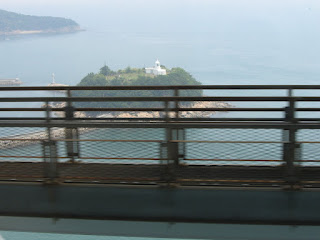

Shikoku was the perfect antidote to the urban blight of Nagoya. It's Japan's 4th largest island, but is kind of a backwater, rugged, mountainous, and rural. Most tourists skip Shikoku, and I had for the last 11 years of coming to Japan, so I was excited to see something new. We took the shinkansen (bullet train) from Nagoya, watching the rice fields zip by in a blur (see the picture of the penguins from the last blog entry). We had to switch to a slow train to cross to Shikoku. There is a long series of bridges spanning the islands of the inland sea. Masami has a mania for reserving seats on trains (which comes in handy at times), but although this train was mostly empty, we had the bottom level of the reserved car, giving us a platform bug's eye view of the scenery. Picturesque little islands alternated with huge industrial type complexes.
Masami is a bit of an internet addict, and found us some good hotel deals for the trip. In Takamatsu we stayed in a business hotel with real beds and soft pillows. I've really become a sort of pillow connoisseur in Japan. So many of them are stuffed full of rice husks, which can be hard as rocks. Newer models are stuffed with plastic tubes, like cut up straws. They remind me of being a kid and going to the ancient egyptian exhibit at the Field Museum in Chicago and marveling at the wooden pillows used by the egyptians.
We had come to Takamatsu in part to visit the Isamu Noguchi house and studio that I had read about in my Lonely Planet guide. The sculptor is world famous for his monumental abstract stone sculptures. To visit the museum by guided tour (which is the only way), the proper procedure is to mail your request at least two weeks in advance and wait for confirmation by return mail (this is Japan, after all). Masami was able to call and save us a spot, explaining that I was a foreigner coming all the way from America to see the museum. There are certain advantages to being an outsider, or gaijin, here.
Isamu wasn't home, as he has been dead for many years. He only lived there three months out of the year even when he was alive, spending the rest of the time in Paris, New York, etc. We weren't allowed to go in his house, but were allowed to peek through the windows. The studio and yard were interesting, with large unfinished chunks of stone everywhere. There were a couple of nice finished pieces in the old barn.
There was a large quarry at the top of the mountain, where he must have gotten the stone for his sculptures. the whole neighborhood, in fact was full of stone carving shops. Although we weren't allowed to take pictures of Isamu's studio or yard, we enjoyed walking around the neighborhood, looking in at all the studios and their yards full of jumbles of stone and finished carvings. There was a little park with promenade lined with huge stone sculptures. The park was overgrown with weeds, and looked abandoned. Although this was June 10, summer doesn't actually begin in Japan until school lets out on July 20. So things are not maintained, especially during the rainy season. It's a great time to travel, though, as many places like this are deserted, as Japanese people wait for the official vacation season.


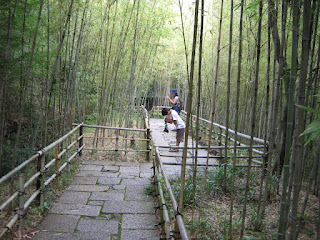
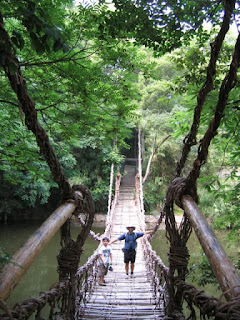
After Isamu's we went to Shikoku Mura, which is a collection of old Japanese buildings, arranged in a spread out sort of village on a hillside. The walking paths were beautiful, winding through the forest. We seemed to be the only ones there. There were birds, lizards, and a nice snake with orange spots. I've been to a couple of other villages like this, but this was the best I've seen. The entrance to the place was a vine bridge (reinforced with steel cables, of course). There were farmhouses, a kabuki theater, stone pathways, bamboo, mossy rocks, streams and waterfalls. They even had a somewhat incongruous insect exhibit. I love the old farmhouses with their organic feel of thatched roofs, wavy log beams, and mud walls. They integrate so well with the natural surroundings. It's rare to find old things in Japan. One theory is that the western culture that they have adopted is so alien to Japanese traditions that the old things are not valued. There is a total disconnect between traditional Japan and modern Japan. So even though this place was a kind of a fantasy, it was the perfect antidote to the shock of my arrival in Japan, and it gave me the strength to face the rest of the trip with some enthusiasm.






 One of the most popular tourist attractions in Shikoku for the past thousand years has been the 88 temple tour. Visiting all of the Buddhist temples is one path to enlightenment, following in the footsteps of the 8th century buddhist saint Kobo Daishi. The first 23 temples on the circuit are around Tokushima. So on Thursday 6/12/08, we decided to take a crack at it. My guidebook had led me to believe that we could do the first ten in a day. It turned out to be a little ambitious. At the first one, pictured above, you can stock up on all the gear you need for your pilgrimage. Above, you can see the latest fashion for pilgrims (not me, the other one) with stick complete with bells on it (no whistles).


